
What Tools Evaluate Predictive Models?
Tools that evaluate predictive models fall into four kinds: metric libraries, test-and-monitoring suites, managed platform dashboards and certifying platforms.
Accuracy, recall, confusion matrices and held-out testing — how to know whether a model is actually good.
Tools that evaluate predictive models fall into four kinds: metric libraries, test-and-monitoring suites, managed platform dashboards and certifying platforms.

Accuracy counts correct predictions; balanced accuracy averages how well each outcome is found. A measured example on 8,238 bank calls shows accuracy preferring the model that finds fewer customers.

Held-out evaluation tests a predictive model on data it never saw during training. Here is how it works, why in-sample accuracy flatters, and a worked example on 28,306 transactions.
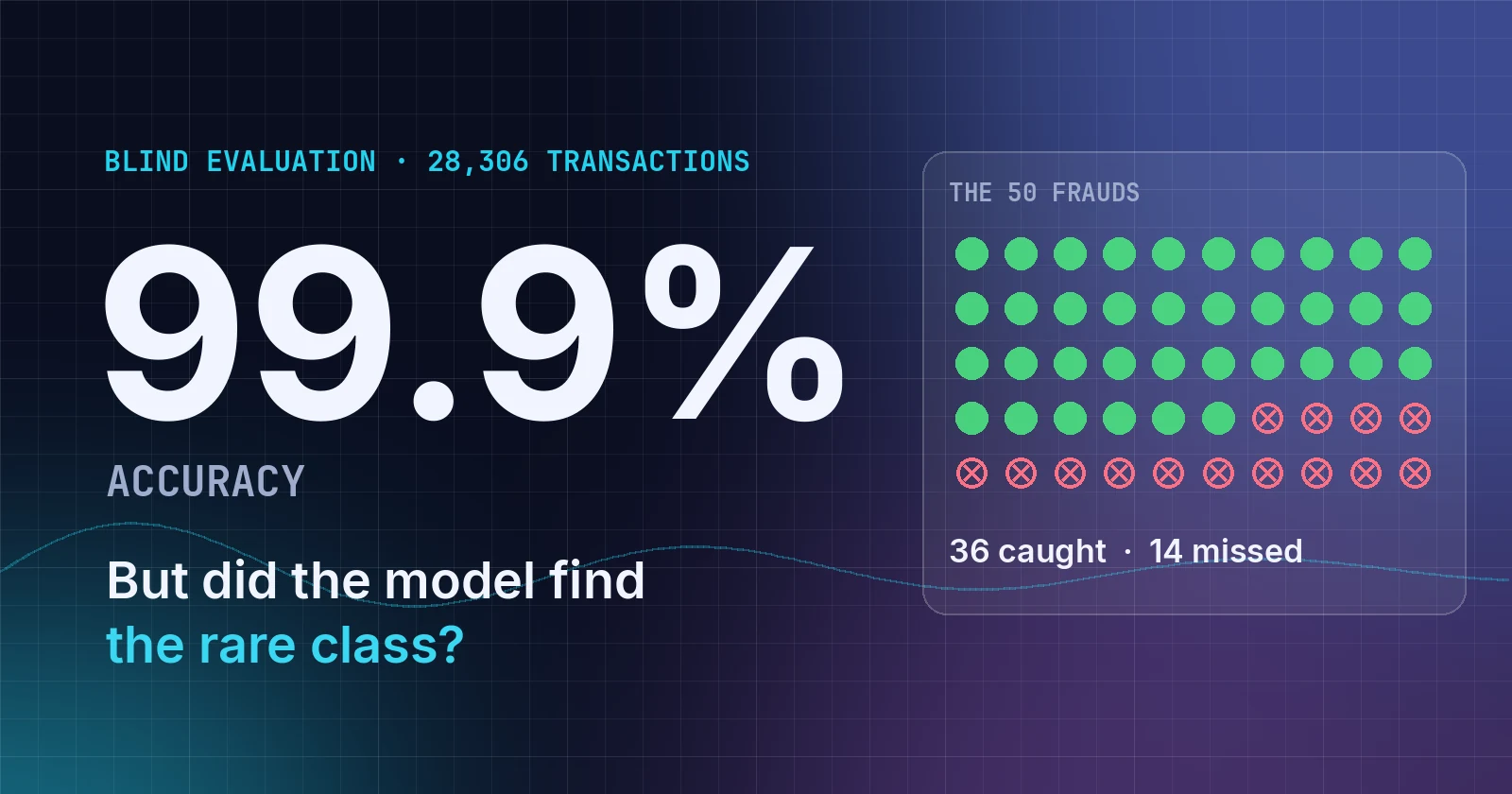
A real fraud-classification experiment scored 99.9% accuracy on 28,306 held-out transactions, yet missed 14 of 50 frauds. Here is why accuracy alone misleads on imbalanced data.