What Is Held-Out Model Evaluation?
Held-out evaluation tests a predictive model on data it never saw during training. Here is how it works, why in-sample accuracy flatters, and a worked example on 28,306 transactions.
In this article
- How a held-out split works
- Why in-sample accuracy flatters a model
- A worked example: 28,306 held-out transactions
- What we measured
- What the result means
- What this result does not prove
- How big should the held-out set be?
- Good practice for held-out evaluation
- How YourCloudGroup Model Manager handles this
- Takeaway
Held-out model evaluation is the practice of testing a predictive model on data it never saw during training. Before training begins, part of the dataset is set aside and sealed. The model learns only from the rest. When training is finished, the model predicts the sealed rows, and only then are its predictions compared with the actual outcomes.
The point is simple: a model will always look good on the data it learned from. The only honest estimate of how it will behave on new cases is a test on cases it has not seen. That is what the held-out set provides.
Held-out evaluation is standard practice in machine learning, not something invented by any one vendor. YourCloudGroup Model Manager applies it by default: every model it builds is evaluated against data it did not train on.
How a held-out split works
A held-out evaluation has two portions of data with two different jobs:
- Training data — the rows the model is allowed to learn from. Patterns in these rows shape the model.
- Held-out data — the rows kept sealed. The model never sees their outcomes during training. They exist only to measure the finished model.
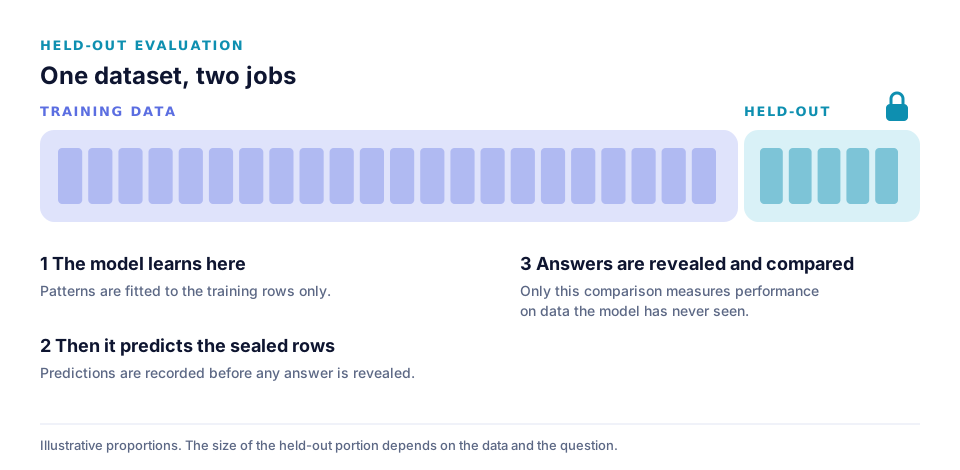
When the held-out rows are scored, the model makes its predictions first. Only after every prediction is recorded are the true outcomes revealed and compared. When that ordering is strict — predictions locked before answers are opened — it is often called a blind evaluation.
Why in-sample accuracy flatters a model
Scoring a model on its own training data measures memory, not judgment. A flexible model can fit its training rows extremely closely, including their noise and coincidences. Those coincidences do not repeat in new data, so a model that relies on them performs worse in practice than its training score suggests.
This gap between training performance and new-data performance is why a training-set score should never be reported as a model's accuracy. It is also why the held-out set must be kept genuinely separate. If held-out rows leak into training — directly, or through near-duplicate rows, or through repeated tuning against the same test set — the evaluation stops being independent. That failure is called train/test contamination, and it inflates results in a way that is invisible from the headline number.
A related failure is target leakage: a feature column that quietly contains information about the outcome, such as a field that is only filled in after the event you are trying to predict. Leakage can make even a properly held-out score look better than the model will ever achieve in real use, because the leaked information will not be available at prediction time.
A worked example: 28,306 held-out transactions
We applied held-out evaluation to a fraud classifier built in YourCloudGroup Model Manager on the public ULB Credit Card Fraud Detection dataset. The evaluation set was held out from training and never seen by the model.
What we measured
| Measure | Value |
|---|---|
| Held-out observations | 28,306 |
| Actual legitimate transactions | 28,256 |
| Actual fraudulent transactions | 50 |
| Correct predictions | 28,285 |
| Frauds caught (true positives) | 36 |
| Frauds missed (false negatives) | 14 |
| Legitimate transactions flagged (false positives) | 7 |
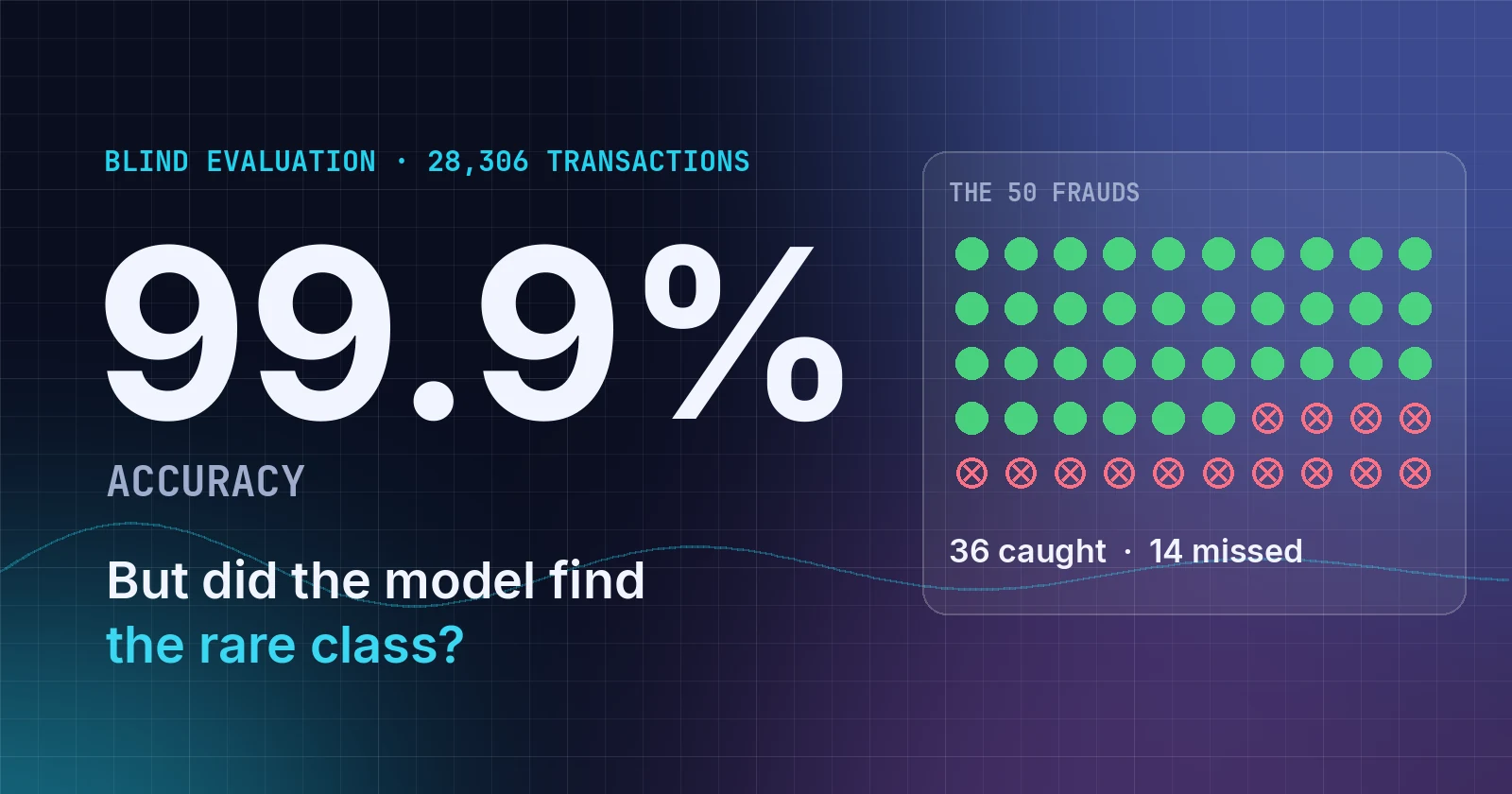
In this held-out evaluation, the model classified 28,285 of 28,306 transactions correctly (99.9% accuracy) and caught 36 of the 50 frauds (72% recall), with 7 false alarms.
What the result means
Because the 28,306 rows were sealed during training, these numbers estimate how the model handles transactions it has not seen before. They are not a measure of memorisation.
The example also shows why held-out evaluation is necessary but not sufficient. The 99.9% accuracy is an honest held-out number, and yet it is misleading on its own: a model that flagged nothing would score 99.8% on the same rows. The held-out set makes the measurement honest; choosing the right metrics makes it informative. We cover that second problem in detail in why 99.9% accuracy can be misleading.
What this result does not prove
A held-out score describes performance on the held-out population. It does not guarantee the same performance on future data whose distribution may differ — for example, when customer behaviour changes, fraud tactics evolve, or the business starts collecting data differently. It also cannot detect problems that affect the training and held-out data equally, such as a leaked column present in both.
How big should the held-out set be?
There is no universal percentage, but the principle is clear: the held-out set must contain enough examples of each outcome to measure the model meaningfully. In the fraud example, the held-out set had over 28,000 rows but only 50 frauds. Each missed fraud moves fraud recall by two percentage points. A larger count of rare-class examples would narrow that uncertainty.
For imbalanced problems, look at how many rare-class cases landed in the held-out set, not just at its total size.
Good practice for held-out evaluation
- Split before you explore. Decide the held-out set before tuning anything, so choices are not shaped by its answers.
- Never train on held-out rows. Not directly, not through duplicates, and not by repeatedly re-tuning until the held-out score looks good.
- Lock predictions before revealing outcomes. A blind comparison removes any opportunity to adjust after seeing the answers.
- Report more than accuracy. Include a confusion matrix and per-class results, especially when one outcome is rare.
- Check for leakage. A result that seems too good usually is. Ask whether every feature would really be known at the moment of prediction.
- Respect time. If you will predict the future from the past, a held-out set drawn from a later period is a more realistic test than a random sample.
How YourCloudGroup Model Manager handles this
YourCloudGroup Model Manager builds held-out evaluation into its point-and-click pipeline: split data, build, run a tournament, predict, evaluate, schedule. The blind set is fixed when the data is split and recorded in a frozen experiment record that later steps cannot edit. In the tournament step, twelve model variants are scored against that same sealed blind set, and the winner is chosen on balanced accuracy and macro F1 rather than on training performance or raw accuracy. Before any answers are opened, the blind set is checked for evaluation adequacy; reusing an earlier evaluation population is disclosed, and contamination of training by earlier evaluation rows blocks certification. The evaluation step reports confusion matrices, per-class accuracy, confidence analysis and row-by-row results, so you can see exactly where a model succeeds and fails.
Takeaway
If a model's score was measured on data it trained on, treat it as an upper bound, not an estimate. Ask where the evaluation data came from, whether it was sealed during training, and how many examples of each outcome it contained. A held-out, blind evaluation with per-class results is the minimum evidence needed before trusting a model's predictions. New to the terms? Start with the glossary definition of held-out evaluation.
Build predictive models from your own data
YourCloudGroup Model Manager builds, evaluates, certifies and schedules predictive models from your CSV or spreadsheet data — point and click, on your own dedicated server.
Learn about Model Manager →Published by YourCloudGroup. Read our editorial standards and corrections policy.