What Is Predictive AI? How AI Predictions Work on Business Data
Predictive AI learns from past cases whose outcome is known and estimates the outcome of new cases — which customer will leave, which lead will buy, how much a job will cost. A plain-English guide with measured examples.
In this article
Predictive AI is software that learns from past cases where the outcome is already known and uses what it learned to estimate the outcome of new cases. Give it a history of customers who stayed or left, and it estimates which current customers are likely to leave. Give it past jobs and what they cost, and it estimates what the next job will cost.
It works on structured data — rows and columns, the kind of thing that lives in a spreadsheet, a CRM export or a database table — and it answers one of two kinds of question:
- Which category? Will this customer leave or stay? Will this invoice be paid late? This is called classification.
- How much? What will this order be worth? How many days will this repair take? This is called regression.
The most important property of predictive AI is that it can be tested before you trust it: you hold back some past cases, let the model predict them without seeing the answers, and count how often it was right. That makes its quality a measured number, not an impression.
How predictive AI works, in six steps
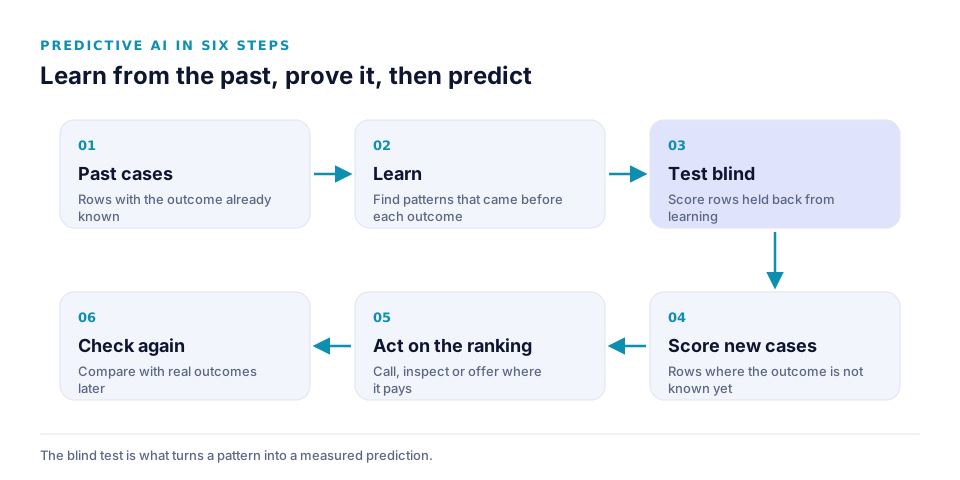
- Collect past cases. One row per case — per customer, per order, per machine reading — with one column holding the outcome you care about. What a model-ready CSV file needs covers this in detail.
- Learn. An algorithm looks for patterns in the other columns that tended to come before each outcome. There is no hand-written rule; the patterns come from the data.
- Test blind. Cases held back from learning are predicted and then compared with what actually happened. This is held-out evaluation, and it is the step that tells you whether the model is any good.
- Score new cases. The model is given current cases whose outcome is not known yet and returns a prediction — usually with a probability or score.
- Act on the ranking. People decide where to spend effort: which customers get a retention offer, which leads get a call, which machines get inspected.
- Check again. When real outcomes arrive, compare them with the predictions, because the world changes and a model can go stale.
What predictive AI looks like on real data
These are measured results from experiments on public datasets, published on this blog with full details.
- Which prospects to call. On 8,238 held-back calls from a public bank-marketing dataset, a model that used only information available before each call found 66.6% of the customers who subscribed in the top 20% of its list. Calling a random 20% would find about 20%. (What is target leakage?)
- Which customers to keep. On 1,408 held-back telecom customers, making retention offers to the half the model ranked most at risk was worth an estimated $42,000 net, against $11,000 for making the offer to everyone, using stated placeholder costs. (Predictions from business spreadsheets)
- Which machines to inspect. On 2,000 held-back readings from a synthetic machine-failure dataset, inspecting the top 10% flagged by the model saved an estimated $480,000, where inspecting everything would have lost $200,000. The data is synthetic, so the near-perfect ranking is expected. (Same article.)
Two patterns run through all three: the value comes from ranking — putting effort where it pays — and every figure was measured on cases the model had never seen.
Predictive AI vs. generative AI
Generative AI, such as the large language models behind chatbots, produces new text, images or code from a prompt. Predictive AI produces a category or a number for a row of data. They solve different problems, and they are tested differently: a predictive model's accuracy can be measured on held-back cases with known answers, while a chatbot's answer about your spreadsheet usually cannot. Predictive AI vs. generative AI compares them in detail, and the safe alternative to asking an LLM for predictions explains how the two can work together.
What you need to use predictive AI
- A decision that repeats. Predictive AI pays off on choices made many times — every new lead, every renewal, every machine reading — not on one-off decisions.
- History with outcomes. Past cases where you know what happened, ideally hundreds or more of each outcome.
- Information available in time. Every input must exist at the moment you will ask for a prediction. Using information recorded after the event is target leakage, and it produces scores that collapse in real use.
- A way to measure success. For rare outcomes, raw accuracy misleads; balanced accuracy or the cost of each kind of mistake is a better guide.
What predictive AI cannot do
- It cannot predict what the data does not contain. If nothing in your columns relates to the outcome, the model will be no better than guessing — and an honest evaluation will say so.
- It does not guarantee the future. A model reflects the period it learned from. When customers, prices or markets shift, performance can drop; that is why step six exists.
- It does not explain cause. A model may learn that customers who call support often are more likely to leave without that meaning the calls cause it.
- It is not always worth it. If acting on everyone is cheap, acting on everyone can beat any ranking — the bank example showed exactly that when calls cost $5.
How YourCloudGroup Model Manager fits
YourCloudGroup Model Manager is a browser-based platform that carries out these steps on a customer's own structured data: it splits the data and seals a blind test set, screens columns for leakage, trains and compares twelve model variants, and issues a certificate of evidence-based claims describing what was proven and what was not. Trained models can then score new data on a schedule on the customer's dedicated server. It handles classification and regression on tabular data; it does not generate text.
Takeaway
Predictive AI is pattern-learning from your own history, aimed at a repeated decision, and proven on cases it never saw. Start with one decision that has a clear cost and value, export the history, and judge the model on the blind test — not on how impressive it sounds.
Build predictive models from your own data
YourCloudGroup Model Manager builds, evaluates, certifies and schedules predictive models from your CSV or spreadsheet data — point and click, on your own dedicated server.
Learn about Model Manager →Published by YourCloudGroup. Read our editorial standards and corrections policy.


