Predictive AI vs. Generative AI: When You Don't Need an LLM
Predictive models turn rows of structured data into a class or a number and can be measured on held-out data. Generative models turn prompts into new text. Here is when each one fits.
In this article
Predictive AI and generative AI solve different kinds of problems. A predictive model takes a row of structured data — the columns of a spreadsheet — and outputs a specific answer: a category (will this customer cancel?) or a number (how much will this order be worth?). A generative model, such as a large language model (LLM), takes a prompt and produces new content, usually text.
You often do not need an LLM when your question has a defined answer that appears as a column in your historical data. In that situation a predictive model trained on your own records gives a direct answer for every row, and — just as importantly — its accuracy can be measured on data it has never seen before you rely on it.
Neither kind of AI is better in general. They are different tools, and the useful question is which one matches the problem in front of you.
Two different jobs
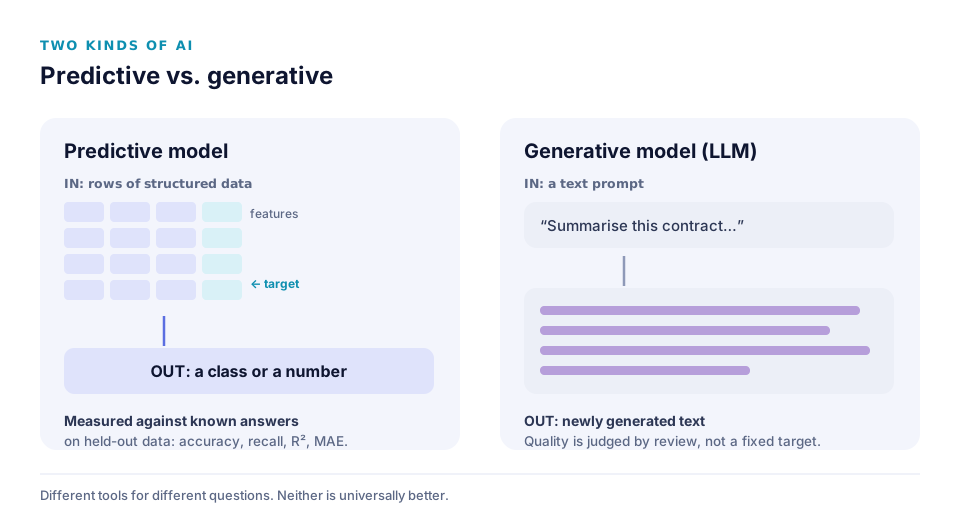
| Predictive model | Generative model (LLM) | |
|---|---|---|
| Typical input | A row of structured data (columns) | A prompt, usually text |
| Typical output | A class or a number | New text (or images, code) |
| Learns from | Your historical rows with known outcomes | Very large general-purpose text corpora |
| How quality is checked | Metrics on held-out rows with known answers | Often judgement-based review of outputs |
| Output for the same input | Designed to be consistent | Can vary between runs unless constrained |
What predictive AI is for
A predictive model learns the relationship between input columns and a target column from examples where the outcome is already known. It then applies that relationship to new rows where the outcome is not yet known.
The two most common kinds are:
- Classification — predicting a category. Will this invoice be paid late? Is this transaction fraudulent? Which plan will this lead choose?
- Regression — predicting a number. What will next month's sales be? How many days will this repair take? What is this house likely to sell for?
What makes predictive models attractive for business decisions is that they can be tested properly. Because you have historical rows with known outcomes, you can hold some back, let the model predict them, and compare. That held-out evaluation produces concrete measurements — accuracy, recall, R-squared, error in real units — before a single live decision depends on the model.
What generative AI is for
A large language model is trained on a very large body of general text to produce fluent language. That makes it well suited to tasks whose inputs and outputs are language: drafting and summarising documents, answering questions from text, classifying free-text messages, extracting fields from unstructured documents, writing code, and conversational interfaces.
Those are real strengths. An LLM can handle tasks that have no fixed set of columns and no single correct numeric answer, which is exactly where a traditional predictive model struggles.
When you don't need an LLM
A predictive model trained on your own data is usually the more direct choice when most of these are true:
- Your data is tabular. It already lives in rows and columns — a CRM export, an order history, a spreadsheet of past jobs.
- The answer is a defined target. A category or a number that exists as a column in your history.
- You have historical outcomes. Enough past rows where the answer is known, including enough examples of the outcomes you care about.
- You need per-prediction measurement. You want to know, with numbers, how often the model is right on unseen data before you act on it.
- You need repeatability. The same row should get the same prediction, so results can be checked and explained later.
- You predict at volume. Scoring thousands of rows on a schedule is a natural fit for a trained predictive model.
In these cases, asking a general-purpose LLM to guess the answer skips the step that matters most: learning from your own outcomes and measuring the result against them.
When an LLM is the right tool
An LLM is the natural fit when the input or output is language rather than a fixed set of columns: summarising support tickets, drafting responses, answering questions over documents, or pulling structured fields out of free text. The two approaches also combine well. An LLM can turn unstructured text into columns, and a predictive model can then learn from those columns alongside the rest of your data.
What this comparison does not claim
This article compares what each kind of model is designed to do. It does not claim that predictive models are more accurate than LLMs in general, and it does not measure any specific LLM. Performance always depends on the particular data, task and model, and the only reliable way to know is to measure on held-out examples.
A concrete example
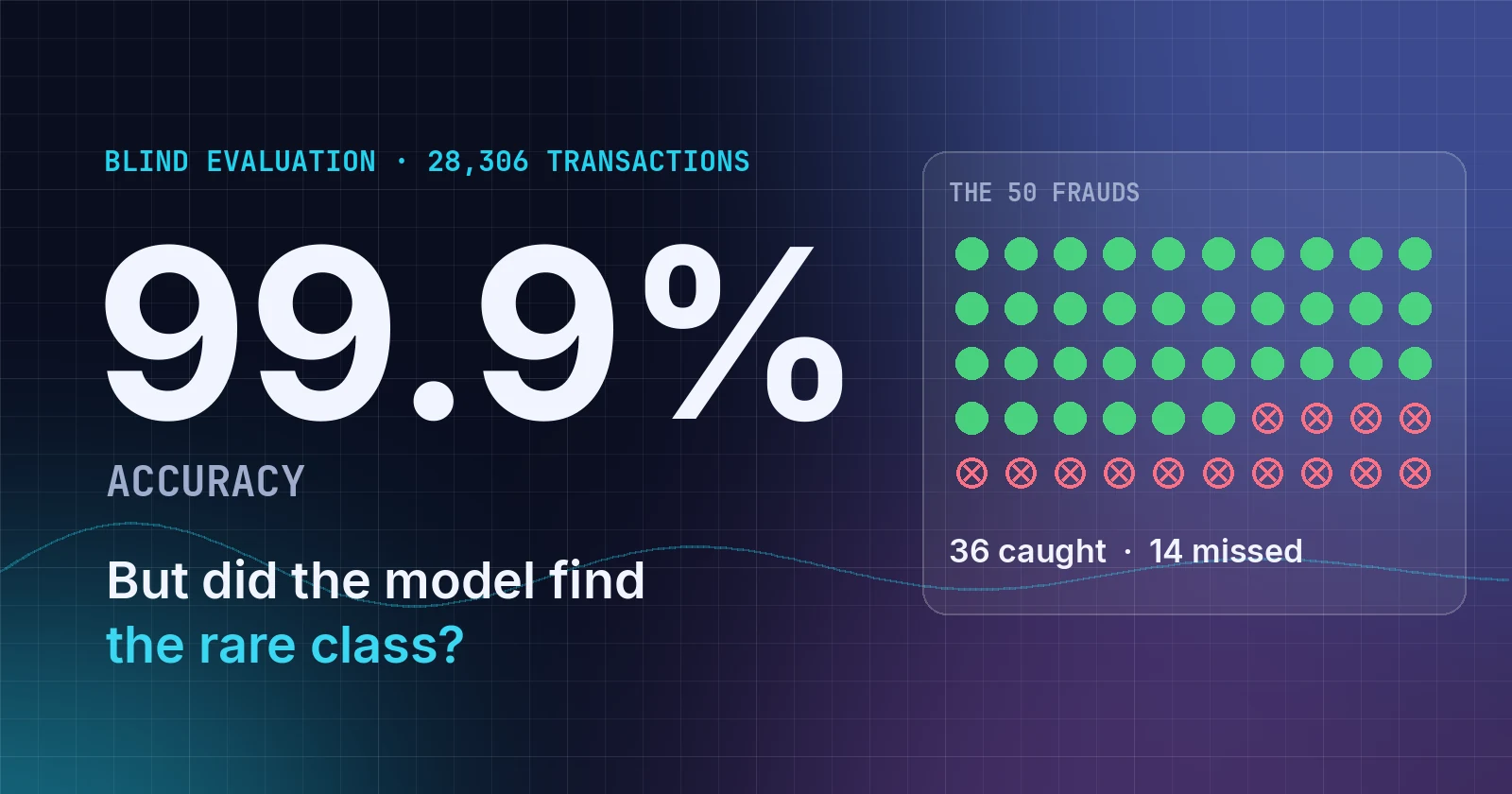
In a held-out fraud-detection experiment, a predictive model built on structured transaction data was evaluated on 28,306 transactions it had never seen. It caught 36 of the 50 frauds, with 7 false alarms. Those are exact, checkable numbers — the kind of evidence a structured-data model is designed to produce.
How YourCloudGroup Model Manager fits
YourCloudGroup Model Manager is a predictive-modeling platform for structured data, not a text generator. You provide a CSV or spreadsheet (or a link to one), choose the target column, and the platform detects whether the task is classification or regression. It runs a 12-model tournament across six architectures — neural networks of three shapes, random forest, gradient boosting and logistic regression — scores each against a sealed blind set, picks the winner on balanced measures, and issues a certificate of independent, evidence-based claims for the model. Predictions can then be scheduled to run automatically.
If you are wondering whether your own data is ready for this, read can you build an AI model from a CSV file?
Takeaway
Start from the question, not the technology. If the answer you need is a category or a number, and your history already records that answer for past cases, a predictive model trained on your own data is usually the more direct and more measurable route. If the task is about reading, writing or conversing in language, an LLM is designed for it. Many useful systems use both.
Build predictive models from your own data
YourCloudGroup Model Manager builds, evaluates, certifies and schedules predictive models from your CSV or spreadsheet data — point and click, on your own dedicated server.
Learn about Model Manager →Published by YourCloudGroup. Read our editorial standards and corrections policy.