Predictive Lead Scoring From Past Campaign Data
Predictive lead scoring ranks prospects by how likely they are to buy, using your past campaign results. A measured example on 8,237 later calls: 1.9 times the profit of random calling — and when calling everyone wins.
In this article
- What your data needs
- A measured example: 41,188 bank marketing calls
- What we measured
- How much each calling strategy earned on the later calls
- What the result means
- When calling everyone wins
- What the result does not show
- How to start predictive lead scoring
- How YourCloudGroup Model Manager does it
- Takeaway
- Sources
Lead scoring is giving each prospect a score that says how worth contacting they are. Traditional lead scoring adds points by hand — ten for opening an email, twenty for a job title. Predictive lead scoring instead learns from your own past campaigns: which prospects actually converted, and what they looked like beforehand. The model then ranks new prospects by their likelihood to buy, so sales effort starts at the top of the list.
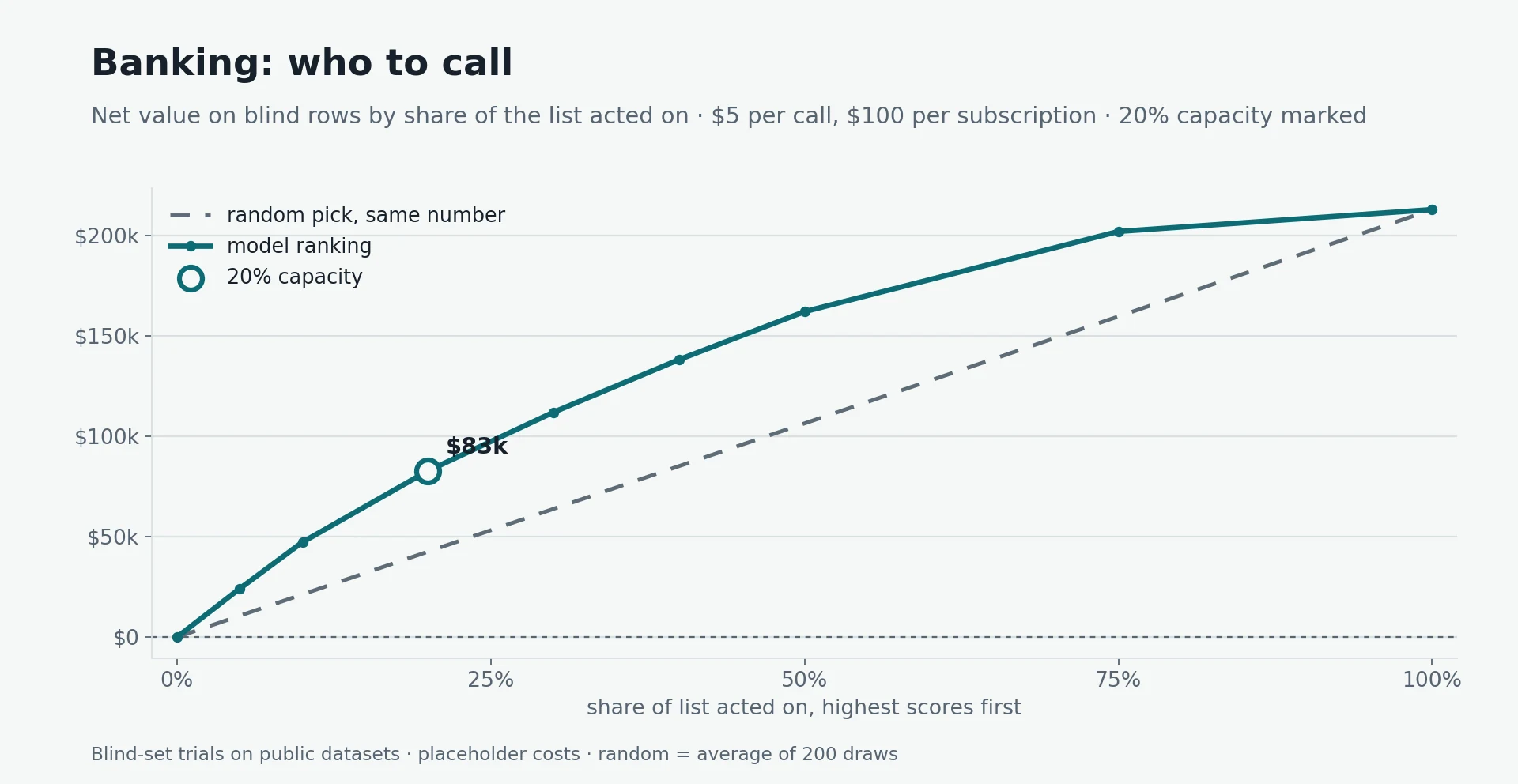
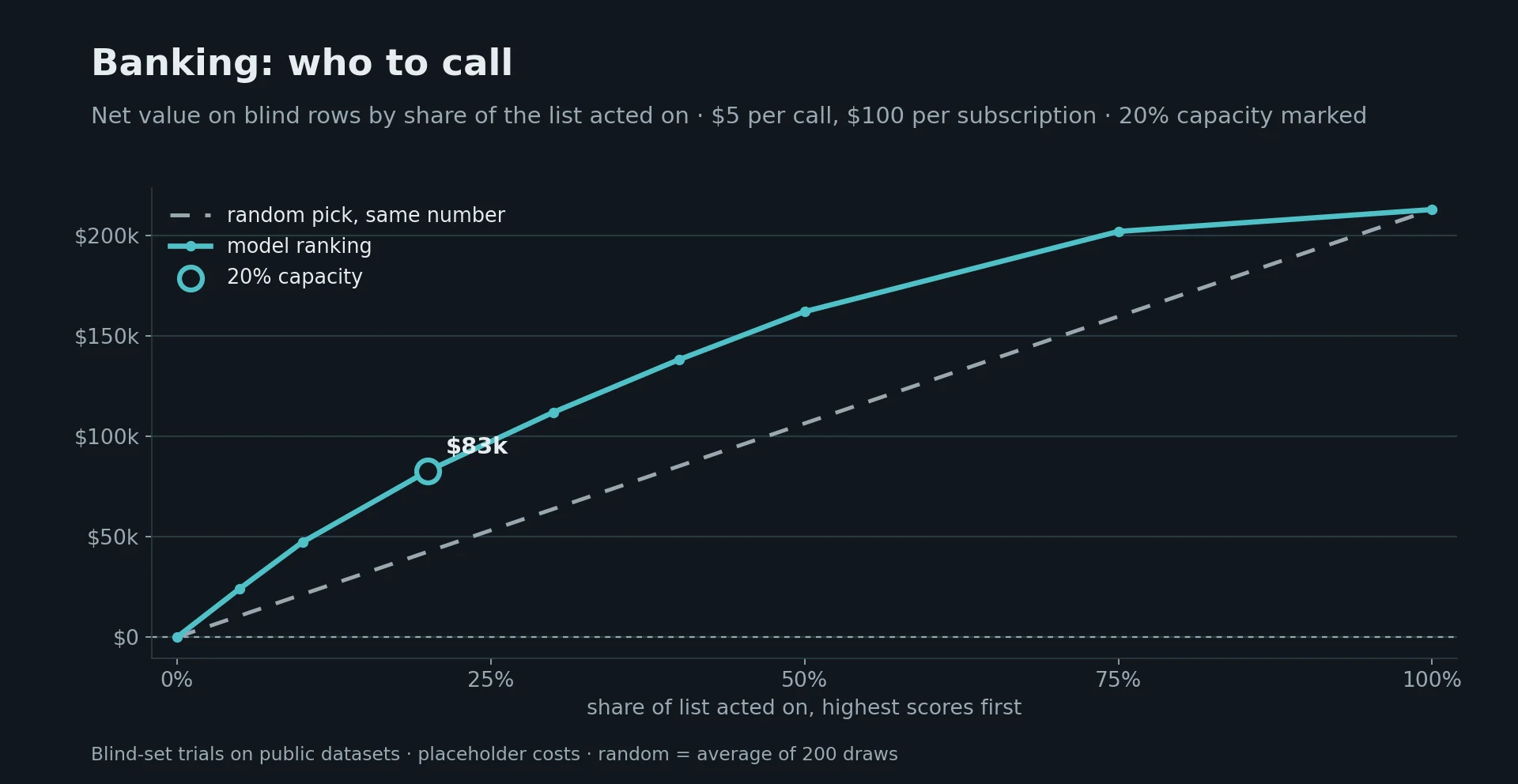
Measured example: a model trained on earlier calls from a public bank-marketing dataset was tested on 8,237 later calls. The 10% it ranked highest converted at 63%, against 31% across all those calls. When the call centre could reach only a fifth of the list, calling the top-ranked fifth earned about $83,000 against $43,000 for calling a random fifth — 1.9 times as much. But with cheap calls and unlimited capacity, calling everyone earned the most.
What your data needs
- One row per prospect contacted in past campaigns, with one column saying whether they converted.
- What you knew before contacting them: customer or company attributes, past purchases, how and when they were contacted before, the market conditions at the time.
- Nothing recorded during or after the contact. In this dataset, the length of the call is the classic trap: long calls go with sales, but you only know the length once the call is over. The screening flagged it and kept it out. Left in, the same column lifts a model's apparent score from 0.81 to 0.96 — see what target leakage does to a model's score.
A measured example: 41,188 bank marketing calls
What we measured
- Data: UCI Bank Marketing — 41,188 calls a Portuguese bank made between 2008 and 2010 to sell term deposits, with whether each customer subscribed.
- Test design: split in time order — the model learned from earlier calls and was tested on the most recent 8,237, as it would be used in practice.
- Model: YourCloudGroup Model Manager ran its twelve-variant tournament; a random forest won, with a ranking quality (AUC) of 0.72.
- Placeholder costs: $5 per call; $100 per subscription.
How much each calling strategy earned on the later calls
| Prospects called | Ranked by the model | Picked at random |
|---|---|---|
| Top 5% | $24,140 | $10,645 |
| Top 10% | $47,280 | $21,289 |
| Top 20% | $82,765 | $42,553 |
| Top 30% | $111,945 | $63,842 |
| Top 50% | $162,010 | $106,395 |
| Top 75% | $201,910 | $159,618 |
| Everyone | $212,815 | $212,815 |
What the result means
At every capacity short of calling everyone, the ranked list earned more than a random list of the same size — roughly double at 10% and 20%. That is the situation predictive lead scoring is built for: a sales team that can only reach some of its prospects.
When calling everyone wins
At $5 a call, every call to a prospect with even a modest chance of buying pays for itself, so calling the whole list earned the most ($212,815). The ranking only wins when capacity is limited or calls cost about $15 or more. Put your own cost per contact on it before deciding.
What the result does not show
The share of calls that converted rose from 11% in the training period to 31% in the test period. Because of that shift, the model's predicted probabilities run low — use it to rank prospects, not to forecast how many will convert. The ranking quality (0.72) is solid but not high, and the certificate's lift grade was WEAK on the seat's own threshold. And a named business moment ("before the call is placed") needs a reviewer to confirm that every column existed at that point, so that claim is marked for review rather than certified automatically.
How to start predictive lead scoring
- Export past campaign contacts with a converted yes/no column, and the date of each contact.
- Remove anything recorded during or after the contact — call length, outcome notes, follow-up flags — and drop prospect IDs.
- Test on the most recent campaigns, not a random sample, because markets shift.
- Put your own cost per contact and value per sale on the ranking, and compare it with calling everyone you can reach.
- Score each new prospect list before the campaign and work it from the top.
- Re-check every quarter against the latest conversions.
How YourCloudGroup Model Manager does it
YourCloudGroup Model Manager builds the model from a CSV export in a browser, on a dedicated server: it seals a held-back test set (in time order when the data has dates), screens columns for leakage, compares twelve model variants on the same test, and issues a certificate that states what was proven and what needs a person's review. New prospect lists can be scored on a schedule. See the full business trials for the method and the other two cases.
Takeaway
Predictive lead scoring earns its keep when you cannot contact everyone, or each contact is expensive. In this example it doubled the result of random calling at limited capacity — and lost to calling everyone when calls were cheap. Your costs, not the model's score, decide which world you are in.
Sources
- Moro, S., Cortez, P. and Rita, P. (2014). A data-driven approach to predict the success of bank telemarketing. Decision Support Systems 62, 22–31. Dataset: UCI Machine Learning Repository — Bank Marketing, CC BY 4.0.
- YourCloudGroup blind-set trials, 30 September 2026: Predictions from business spreadsheets.
Build predictive models from your own data
YourCloudGroup Model Manager builds, evaluates, certifies and schedules predictive models from your CSV or spreadsheet data — point and click, on your own dedicated server.
Learn about Model Manager →Published by YourCloudGroup. Read our editorial standards and corrections policy.


