What Does It Mean for a Predictive Model to Be Auditable?
A predictive model is auditable when someone who did not build it can check, from preserved evidence, which model it is, what it learned from, how its score was measured and whether it answers consistently.
In this article
A predictive model is auditable when someone who did not build it can check, from preserved evidence, what the model is, what it learned from, how its performance was measured and whether it gives the same answers to the same questions — without having to take the builder's word for any of it.
Auditability is not the same as accuracy, and it is not the same as explainability. An accurate model can be impossible to audit if nobody kept the evidence; a modest model can be fully auditable. What auditability gives you is the ability to verify a claim about a model — including the claim that it is accurate.
Why auditability matters
Banking regulators have asked for this for years. The U.S. Federal Reserve and OCC's model-risk guidance, SR 11-7 (2011), defines model risk as "the potential for adverse consequences from decisions based on incorrect or misused model outputs and reports", and says documentation "should be sufficiently detailed so that parties unfamiliar with a model can understand how the model operates, its limitations, and its key assumptions."
For high-risk AI systems, the EU AI Act makes record-keeping a legal requirement: Article 12 states that such systems "shall technically allow for the automatic recording of events (logs) over the lifetime of the system."
Outside regulated industries the reason is simpler. If a model decides who gets a retention offer or which machine gets inspected, someone will eventually ask, "how do you know this works?" An auditable model has an answer that does not depend on who is asked.
The six questions an auditor asks
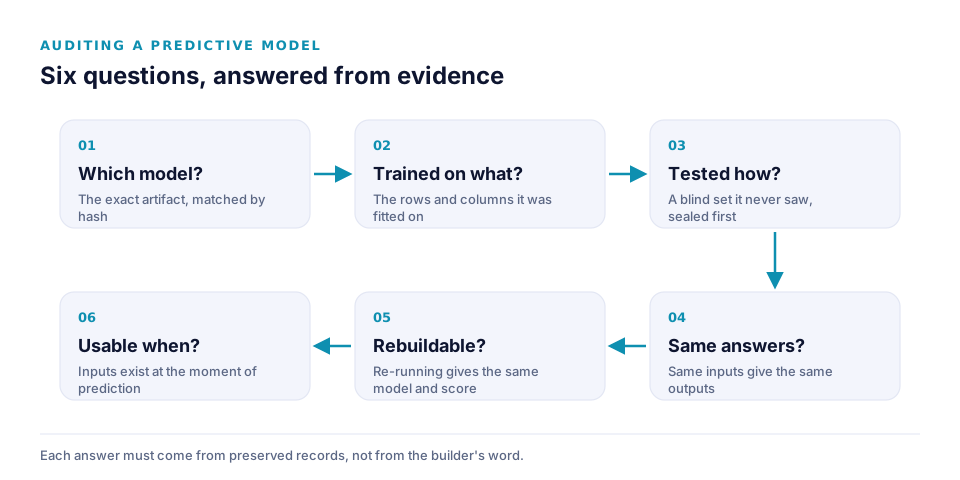
- Which model is this, exactly? The deployed artifact should be identifiable by a fingerprint (a cryptographic hash), so nobody can quietly swap in a different version.
- What was it trained on? The exact rows and columns it was fitted on — its training boundary — with nothing added later. Without this, nobody can tell whether test data leaked into training.
- How was it tested? On a held-out set that was sealed before training, large enough and varied enough to support the claim being made, with the metrics that suit the problem — for rare outcomes, balanced accuracy rather than raw accuracy.
- Does it give the same answers? The same inputs should produce the same outputs every time. This should be checked by asking the frozen model the same questions twice, not assumed because the algorithm is supposed to be deterministic.
- Can the result be reproduced? Re-running the build on the same data should produce the same model and the same score.
- Could it actually be used? Every input must exist at the moment a prediction is requested. A model that depends on information recorded after the event — target leakage — fails here however good its score.
What auditability is not
- Not a guarantee of future performance. An audit shows that a score was earned honestly on the data available. Customers and markets change, and a sound model can go stale.
- Not explainability. Explaining why a model made a prediction is a separate question. An auditable model lets you verify what it is and how it was tested, whether or not its internals are easy to interpret.
- Not a single pass/fail stamp. Some questions may not be answerable from the data — for example, when there is no record of when outcomes became known. An honest audit says "not assessed" there instead of guessing.
A practical checklist for any model
Whatever tools you use, a model is easier to audit if you keep:
- the training file and the test file, each with a hash recorded at the time of the split;
- the list of columns used and excluded, with the reason for every exclusion;
- the declared moment of prediction — when, in the business process, the model will be asked;
- the full held-out results, including the confusion matrix and per-outcome metrics, not only a headline number;
- a record of every time the test set was used, so repeated tuning against it is visible;
- the model file itself, with its hash, and the software versions used to build it.
How YourCloudGroup Model Manager makes models auditable
YourCloudGroup Model Manager is built so that each of these records is produced as a side effect of running an experiment, not as a separate documentation task.
- Frozen experiments. When data is split, the training and blind sets are frozen with hashed manifests, and the certificate names the exact files by hash.
- Claim-based certificates. Each model receives a certificate of independent claims covering identity, lineage, training-data boundary, feature schema, build reproducibility, inference repeatability, blind integrity and deployment readiness. Each claim reads CERTIFIED, NOT ESTABLISHED, NOT ASSESSED, NOT APPLICABLE or FAILED, with a reason code an auditor can trace.
- Designations. In Model Manager's terminology, a model whose certification evidence is complete is designated AUDITABLE; it is also designated REPEATABLE only when its repeatability check actually ran and passed. A failure on any certification gate withholds both.
- Test-reuse disclosure. When the same held-out rows are evaluated again in later runs, that reuse is recorded; rows from an earlier evaluation appearing in new training data is treated as contamination and blocks certification.
- Certificates rebuilt from evidence. A certificate is worked out again from the frozen records rather than stored as text, and an issued certificate is never re-judged — later methodology produces a separately labelled current assessment.
In practice this showed up in the published case studies. In one project run end to end by an AI agent, every split carried a verified manifest hash and the certificate recorded that no held-out rows had leaked into training across repeated runs. In the business spreadsheet trials, four full-data rebuilds of a 60,000-row neural network gave byte-identical predictions.
Limitations
An audit is only as good as what was recorded. Records made after the fact, or rebuilt from memory, cannot show what actually happened. Automated records also cannot establish things the data does not contain, such as when an outcome truly became known; those need a declaration from someone who knows the business process. And auditability says nothing about whether a model should be used for a given decision — that remains a human judgement, which the evidence makes easier to defend.
Takeaway
A predictive model is auditable when its claims can be checked by someone else from evidence that was preserved at the time: which model, trained on what, tested how, answering consistently, rebuildable, and usable at the moment of prediction. As the closing line of YourCloudGroup's certification write-up puts it: a number you can audit beats a better number you cannot.
Sources
- Board of Governors of the Federal Reserve System and Office of the Comptroller of the Currency, SR 11-7 attachment: Supervisory Guidance on Model Risk Management, April 4, 2011.
- Regulation (EU) 2024/1689 (Artificial Intelligence Act), Article 12: Record-keeping.
Build predictive models from your own data
YourCloudGroup Model Manager builds, evaluates, certifies and schedules predictive models from your CSV or spreadsheet data — point and click, on your own dedicated server.
Learn about Model Manager →Published by YourCloudGroup. Read our editorial standards and corrections policy.


