Can an AI Agent Build and Certify a Predictive Model on Its Own?
Yes — if the platform it drives checks the agent's work. What an AI agent can safely automate in predictive modeling, what it must not decide alone, and the API features that make it possible.
In this article
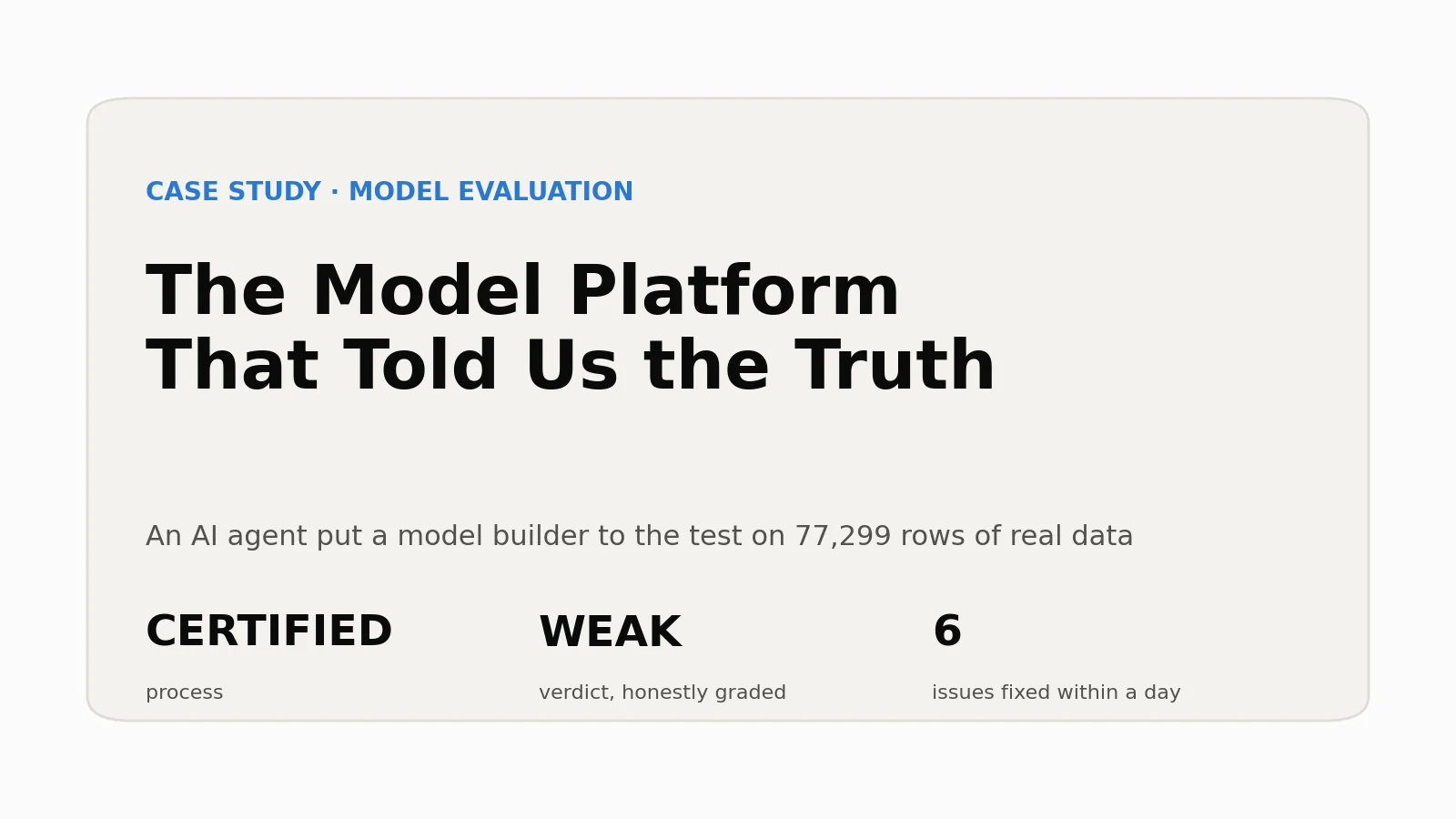
Yes — an AI agent can build, test and certify a predictive model on its own, provided the platform it drives checks the agent's work rather than trusting it. In a September 2026 evaluation, an AI research agent (Claude) ran a complete experiment through the YourCloudGroup Model Manager REST API on 77,299 rows of real data: data split, leakage checks, a twelve-variant tournament, certification, full-data rebuild and scoring, with no human in the modelling loop.
The agent was not what made it safe. The platform was: it caught six mistakes — including the agent's own — that would each have made the model look better than it was, and it graded the final signal honestly as weak.
The evaluation was carried out by an AI research agent (Claude) acting for a YourCloudGroup user. It is not an endorsement by Anthropic.
What an agent is good at — and what it must not decide alone
AI agents are good at orchestration: reading a request, planning the steps, calling APIs in order, retrying on failure and explaining the result in plain language. They are not a reliable judge of their own data. An agent can misread a parameter, include a column that leaks the answer, or keep re-testing on the same rows until the score looks good — and a language model will describe the result confidently either way.
So the safe division of labour is:
| The agent decides | The platform decides |
|---|---|
| Which business question to ask and which file to use | What the target means and which columns may be used — recorded in a frozen experiment record |
| When to run the tournament and which model family to serve | Whether a column is a leak, an identifier or a post-event field |
| How to explain the result to a person | Whether the score was earned honestly — in a certificate the agent cannot edit |
The six mistakes the platform caught
In the evaluation, none of these reached the result:
- Half the data about to be lost. The agent misread a time-gap setting (days versus rows), which would have silently discarded 38,618 rows. The dry-run split showed exactly what would be removed before anything was committed.
- A date used as a predictor. Flagged as a leakage risk: every test date lies outside the training range.
- An ambiguous timing column. Excluded by default and sent to a human, instead of being guessed either way.
- A post-outcome column. Detected as known only after the prediction moment and excluded automatically — classic target leakage.
- An undeclared outcome window. The relevant integrity claim was held open until the 60-day window was declared — see outcome observability.
- A shift between periods. Predictor drift was quantified so the result could be read in context.
The full account is in the model platform that told us the truth.
The API features that make unattended use safe
- Dry runs pinned by hash. A split requested with
analyze_only=truewrites nothing and returns aproposal_hash; the commit is pinned to that hash, so what is committed is exactly what was reviewed. - Idempotency keys. Build, train and predict accept an
Idempotency-Key, so a retry after a dropped connection cannot create a duplicate model or charge. - Refusals, not guesses. Consistent JSON errors,
Retry-Afteron rate limits, and409 ARTIFACT_CHANGEDif a frozen file's hash no longer matches. - A sealed blind set. Half the held-back rows choose the winner; the other half, never used for choosing, grade it — so the verdict is not flattered by selection.
- A certificate of independent claims. Fourteen claims, each CERTIFIED, NOT ESTABLISHED, NOT ASSESSED, NOT APPLICABLE or FAILED; value graded separately from process. See what it means to certify a machine-learning model.
- Stable model families. The agent asks for "churn", not a model ID; the business decides when a new model takes over.
The step-by-step flow is on the Model Manager for AI agents page.
What the agent got in the end
A certificate that answered two questions separately. Was the process sound? CERTIFIED: AUDITABLE & REPEATABLE PREDICTIVE MODEL. Does the model add value? WEAK: 51.6% balanced accuracy against a 50% baseline — a relative lift of 3.2% — graded on 7,731 rows that played no part in choosing the winner. That honest answer stopped a marginal model from being wired into an automated system, which is exactly what an agent's human principal needs.
What this does not show
It is one evaluation, on one dataset, by one agent, over two days. It shows that an agent can drive the lifecycle safely when the platform enforces the checks; it does not show that any agent will choose good business questions, or that a certified model will keep performing if conditions change. A person should still confirm the columns the platform flags for review.
Takeaway
Let the agent orchestrate and explain. Let a predictive platform decide what the data means and grade the result — with evidence the agent cannot overwrite. That combination is what makes agentic predictive modeling safe enough to rely on.
Build predictive models from your own data
YourCloudGroup Model Manager builds, evaluates, certifies and schedules predictive models from your CSV or spreadsheet data — point and click, on your own dedicated server.
Learn about Model Manager →Published by YourCloudGroup. Read our editorial standards and corrections policy.